The Flag of the Åland Islands
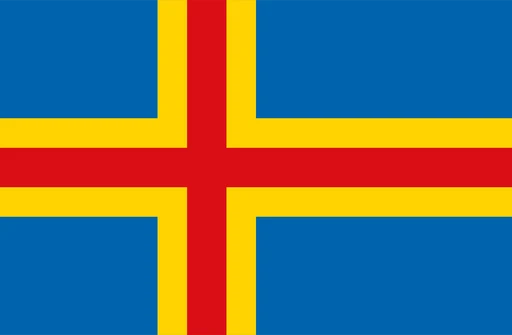
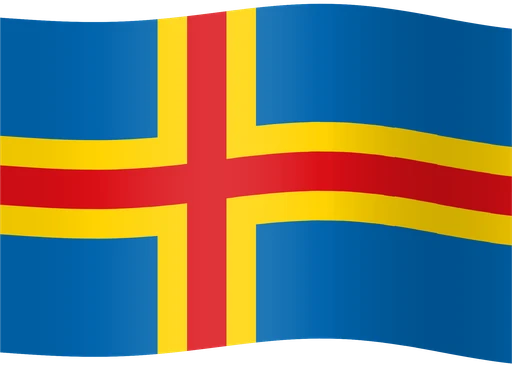
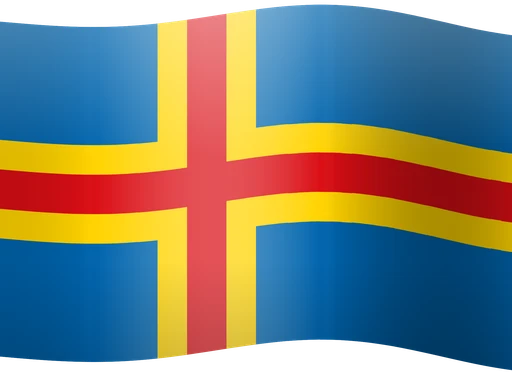
The flag of the Åland Islands is a blue field with a yellow Nordic cross, its vertical arm shifted toward the hoist, charged with a narrower red cross so that the yellow shows as a border. The proportions are 17:26. Blue and yellow are the colors of Sweden and of Åland's provincial arms, and red comes from the coat of arms of Finland: a Swedish-speaking region, inside the Finnish state, drawn as one flag. It flies on public buildings and Åland-registered vessels, and across the islands on Åland's own flag day, the last Sunday of April.
The flag of the Åland Islands is a diplomatic settlement rendered in cloth. At first glance it is simply the Swedish flag, blue with a yellow cross, which is the point: the roughly 30,000 people of this Baltic archipelago speak Swedish, and their autonomy exists to keep it that way. Look again and there is a red cross set inside the yellow one, red and yellow being the colors of Finland's coat of arms, because Åland is, by decision of the League of Nations in 1921, part of Finland. The design was a compromise forced by a presidential veto, and like the larger arrangement it stands for, it has held since the 1950s.
An island question settled in Geneva
Åland sits in the mouth of the Gulf of Bothnia, between Sweden and Finland, and for centuries it went wherever Finland went: part of the Swedish realm until 1809, then part of the Russian Empire's Grand Duchy of Finland. When Finland declared independence in 1917, the Ålanders saw their chance to go the other way. Mass petitions calling for reunification with Sweden circulated on the islands, and the dispute between Stockholm and Helsinki grew serious enough that it landed before the newly created League of Nations.
In June 1921 the League delivered one of its few durable successes. Finland kept sovereignty over Åland, but the islands received wide-ranging autonomy with international guarantees for the Swedish language, local land ownership, and Åland's demilitarized status, which dated back to the Treaty of Paris in 1856. Finland's Autonomy Act gave the islands their own parliament, which convened for the first time on June 9, 1922. That date is still celebrated as Autonomy Day, and the whole arrangement is regularly cited in textbooks on conflict resolution as proof that a territorial dispute can end without anyone shooting.
The forbidden tricolor
Autonomy did not come with a flag. From the 1920s Ålanders flew an unofficial horizontal tricolor of blue, yellow, and blue, Swedish colors arranged so as not to copy the Swedish flag outright. Helsinki tolerated it for a while, then didn't: in 1935 the Finnish government banned the tricolor. For nearly two decades the islands whose special status was guaranteed by international agreement had no lawful flag of their own.
The opening came with the revised Autonomy Act of 1951, which entered into force in 1952 and expanded Åland's self-government, including, for the first time, the right to adopt a provincial flag. The Åland parliament promptly reached for the obvious design: the Swedish flag with a blue cross added inside the yellow one. President J. K. Paasikivi refused to confirm it, on the grounds that it was too close to the flag of Sweden. A second round produced the compromise that stuck. Keep the Swedish base, but set a red cross inside the yellow, tying the flag to Finland's red-and-yellow arms. The red drew grumbles in Åland, where the color had no tradition, but the flag law passed in 1954 and the new flag was hoisted for the first time outside the town hall in Mariehamn on April 3, 1954.
Construction and colors
The flag's proportions are 17:26, and the cross is offset toward the hoist in the standard Nordic manner. Along the hoist the bands run 6:1.5:2:1.5:6 (blue, yellow, red, yellow, blue), and along the length 8:1.5:2:1.5:13, so the red cross is a narrow core with an even yellow border on a wide blue field. The colors were fixed by an Åland government regulation in 2004: Pantone 2945C for the blue, 116C for the yellow, and 186C for the red.
Several Nordic flags set one cross inside another, but Åland's is the only one built from the full national palettes of two countries at once: Sweden's colors carry Finland's colors inside them. Vexillologically the flag says in one image what the Autonomy Act takes dozens of sections to say in law.
Where the flag flies
The flag is both civil and state flag on land and is the ensign for vessels registered in Åland, a meaningful detail in an archipelago with a long shipping tradition; Mariehamn was once home to the world's last commercial fleet of ocean-going windjammers, and one of them, the four-masted barque Pommern, is preserved in the harbor as a museum ship.
The last Sunday of April is the official day of the Åland flag, and June 9 brings the flags out again for Autonomy Day. The flag also travels on mail: Åland has issued its own postage stamps since 1984, and the flag was the natural subject of early issues. Åland maintains other trappings of near-statehood within Finnish sovereignty, including its own vehicle plates, its own top-level internet domain (.ax), and separate membership in the Nordic Council. The islands use the euro, as Finland does, and Swedish remains the sole official language, which is what the flag was about in the first place.
References
[1] "Flag of Åland," Wikipedia. https://en.wikipedia.org/wiki/Flag_of_%C3%85land
[2] "Åland Islands," Flags of the World. https://www.fotw.info/flags/ax.html
[3] "Aaland Islands - Fact Sheet," Flags of the World (CRW Flags mirror). https://www.crwflags.com/fotw/flags/ax_fact.html
[4] "Åland's Flag - History and Meaning," Ålandsbutiken. https://www.alandsbutiken.com/en/the-flag-of-aland/
[5] Landskapsförordning (2004:15) om riktlinjer för Ålands flaggas färger, Åland provincial regulation specifying the flag's colors.
Common questions
- Why does the Åland flag look so much like Sweden's?
- Deliberately. Åland's population is Swedish-speaking, and its autonomy exists precisely to protect that language and culture within Finland. The flag is the Swedish blue-and-yellow cross with a red cross laid inside the yellow one, red and yellow being the colors of Finland's coat of arms.
- What does the red cross in the flag stand for?
- The red is generally read as Finland, since red and yellow are the colors of the Finnish coat of arms. It was also a political necessity: Åland's first proposal had no red at all and was rejected by Finland's president for looking too Swedish. Some Ålanders objected to the red in 1954 because it had no local tradition, but it made the flag possible.
- When was the Åland flag adopted?
- In 1954, under a flag law passed after the 1952 Autonomy Act gave Åland the right to a flag of its own. It was hoisted for the first time in the capital, Mariehamn, on April 3, 1954. Before that, an unofficial blue-yellow-blue tricolor had been in use from the 1920s until Finland banned it in 1935.
- Is Åland an independent country?
- No. Åland is an autonomous, demilitarized, Swedish-speaking region of Finland with its own parliament, its own stamps, and its own flag. The arrangement dates from a 1921 League of Nations decision and is often cited as a model for settling territorial disputes through autonomy.
- When is Åland's flag day?
- The last Sunday of April is the official day of the Åland flag. June 9, Autonomy Day, is another major flag-flying day; it marks the first session of Åland's parliament in 1922.
Featured in these articles
- The Cross That Conquered the North: How Denmark's Dannebrog Became the Template for an Entire Continent
- The Island That Designed Itself Into a Corner: How Greenland's Flag Quietly Broke Every Arctic Convention
- The Cross That Started It All: How Denmark's Dannebrog Became the Template for Every Nordic Flag
- Blue Stripes, Blue Identity: How Israel, Uzbekistan, and the Åland Islands Use Blue-and-White to Mean Completely Different Things
Download this flag
Free in 12 styles, from 32px icons up to 2000px, as SVG, PNG, WebP and JPG.