The Flag of Andorra
Principality of Andorra
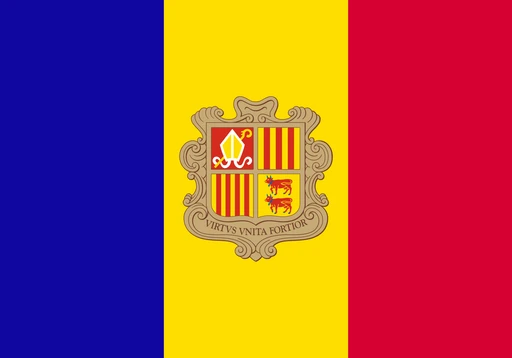
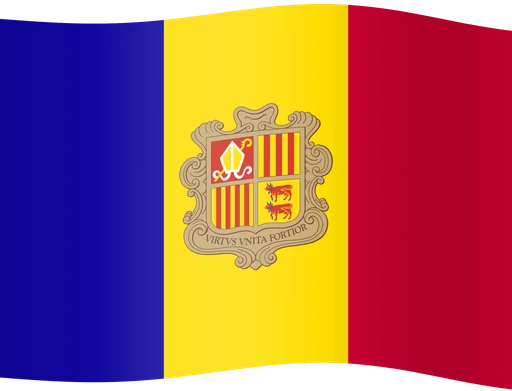
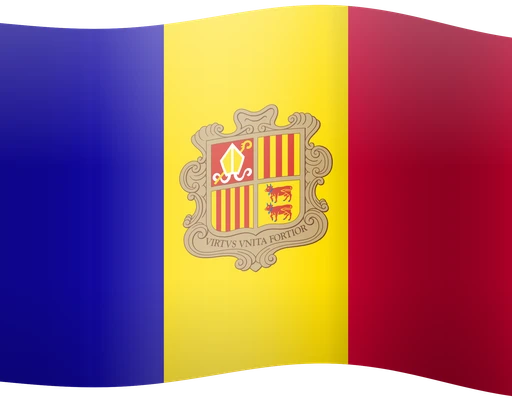
Andorra's flag is a vertical tricolor of blue, yellow, and red, with the yellow band wider than the other two and the national coat of arms in its center. The arms carry a mitre, a staff, and two cows, marking the country's historical ties to both France and Spain.
Andorra's flag carries a coat of arms that amounts to a diagram of the country's political history. The vertical tricolor of blue, yellow, and red is easily confused with the flags of Chad, Romania, and Moldova, and only the arms in the center make it unmistakably Andorran. Quartered to represent the nation's four traditional co-protectors, they record a centuries-old arrangement of shared sovereignty between a French head of state and a Spanish bishop that is still in force.
Two princes, four quarters
The President of France is, technically, a co-prince of Andorra. The arrangement dates to the Pareatge of 1278, a pair of feudal charters that established joint sovereignty over Andorra between the Bishop of Urgell in Catalonia and the Count of Foix in southern France. The Count of Foix's share passed by marriage and inheritance to the Kings of Navarre, then to the Kings of France, and after the Revolution to the French head of state. Emmanuel Macron holds the title today, as does Joan Enric Vives Sicília, the current Bishop of Urgell. Both co-princes still formally approve Andorran legislation.
The coat of arms tells that story in four quarters. Upper left: the mitre and crosier of the Bishop of Urgell, the Spanish ecclesiastical co-prince. Upper right: three vertical red bars, or pallets, on gold, the arms of the Count of Foix, for the French lineage. Lower left: four red pallets on gold, the bars of the Crown of Aragon and Catalonia. Lower right: two red cows on gold, the heraldic emblem of the Counts of Béarn, another link in the French chain of succession. Beneath the shield a scroll carries the motto Virtus Unita Fortior, "United virtue is stronger."
The quartering is a diplomatic balance, two French-linked quarters against two Spanish-linked ones, and every revision or reproduction of the arms has had to keep it. For a country of roughly 80,000 people in 468 square kilometers of Pyrenean valleys, the arms say that Andorra belongs equally to both protectors and therefore fully to neither.
Where the tricolor came from
The tricolor's origins are murkier than the coat of arms. A common story credits the blue-yellow-red design to the influence of Napoleon III in the mid-19th century, though the documentary evidence for it is thin. What is broadly accepted is that the scheme reflects Andorra's position between its neighbors: blue and red from the French tricolore, yellow and red from the Spanish national colors. Whether that was a deliberate compromise or simple convergence, nobody can say for certain.
The flag existed in various informal forms through the 19th and early 20th centuries, with the coat of arms rendered differently by different artists. Some versions were ornate, others plain. The heraldic cows of Béarn in particular have appeared in wildly different styles over the decades.
1993 settled it. Andorra adopted its first written constitution that year, becoming a parliamentary democracy while keeping the co-princes as joint heads of state, and the flag got formal legal standing for the first time. Article 2.2 of the Constitution specifies the design, and later legislation standardized the proportions and the rendering of the arms.
Andorra, Chad, Romania, and Moldova
Strip away the coat of arms and Andorra's flag is almost indistinguishable from Romania's, which is in turn nearly identical to Chad's. The difference between Chad and Romania is a barely perceptible shade of blue, Chad's being slightly darker. Add Andorra's plain tricolor and there are three flags that pass for triplets at any distance.
This is not a hypothetical concern. Chad raised the issue of flag similarity at the United Nations in 2004, arguing that Romania's flag was too close to its own. Nothing changed. Moldova is a fourth near-twin, though its central coat of arms, an eagle holding a shield, keeps it identifiable, much as Andorra's arms do.
So for Andorra the coat of arms is the only thing that makes the flag recognizable. The plain civil variant exists on paper but is almost never flown officially. Vexillologists point to this cluster of tricolors as one of the clearest cases of convergent design in the world's flag inventory: four countries on two continents arriving at the same visual solution by unrelated routes.
Variants and protocol
Three variants are recognized. The state flag carries the full coat of arms centered on the yellow stripe. The civil flag leaves the arms off. An institutional version also exists for official use. In practice the state flag dominates, and you will rarely see the plain version anywhere in the principality.
Official proportions are 7:10, wider than a square but noticeably different from the 2:3 ratio standard across much of Europe, which gives the flag a more compact look when it hangs vertically on a building facade.
Protocol reflects the co-principality. At the Casa de la Vall, the stone building in Andorra la Vella that housed the parliament for centuries, the Andorran flag flies alongside the French tricolore and the Spanish flag, and the same trio appears at border crossings and in diplomatic settings. Andorra is not an EU member or candidate, so the flag does not appear in EU institutional displays, but it does at Council of Europe meetings, where Andorra has been a member since 1994.
At the Olympic Games, Andorra's delegation, sometimes fewer than ten athletes, marches behind the state flag. The country has competed in every Winter Olympics since 1976 and every Summer Olympics since 1996.
Catalan roots
Andorra is the only sovereign state whose official language is Catalan, and that identity runs through the flag's heraldry. Two of the four quarters, the bars of Foix and the bars of Catalonia and Aragon, are variations of the senyera, the red-and-gold striped emblem that is one of the oldest heraldic devices in Europe, dating to at least the 12th century.
The flag is taught in Andorran schools as part of civic education. Children learn the meaning of each quarter, the story of the Pareatge, and the motto. The idea of surviving through diplomatic balance rather than military strength is central to how Andorrans describe themselves, and the four quarters still map the same relationships they did in the 13th century.
The 1993 constitution did more than give the flag legal standing. Andorra joined the United Nations the same year, and the flag started appearing in the General Assembly hall and at international organizations. For a microstate that had operated for seven centuries on medieval legal arrangements, the change was abrupt. The flag stayed the same; its audience got much larger.
References
[1] Constitution of the Principality of Andorra (1993), Title I, Article 2.2. Official legal basis for the national flag and coat of arms.
[2] Govern d'Andorra (Government of Andorra) official website. Flag specifications and state protocol. www.govern.ad
[3] Smith, Whitney. Flags Through the Ages and Across the World. McGraw-Hill, 1975. Comprehensive vexillological reference covering Andorra's flag history and variants.
[4] Znamierowski, Alfred. The World Encyclopedia of Flags. Lorenz Books, 2001. Comparative flag reference including analysis of the Chad-Romania-Andorra similarity cluster.
[5] Lluelles, Maria Jesús. La transformació econòmica d'Andorra. L'Avenç, 2004. Historical and political context of Andorran modernization and the 1993 constitutional reform.
[6] FIAV (Fédération internationale des associations vexillologiques). International vexillology standards and flag classification guidelines.
Common questions
- What do the colors of the Andorran flag mean?
- The blue, yellow, and red point to the influence of France and Spain. Blue and red come from France, yellow and red from Spain.
- Why does the Andorran flag feature a coat of arms?
- The arms show Andorra's co-principality with France and the Bishop of Urgell. The mitre and crosier in one quarter belong to the bishop, and the rest of the shield records the other parties to that arrangement.
- Why is the President of France on Andorra's coat of arms?
- The French president is technically a co-prince of Andorra. It goes back to a 1278 power-sharing deal called the Pareatge. The title originally belonged to the Count of Foix, then passed to the Kings of Navarre, then to the French crown. After the Revolution it transferred to whoever holds the office of head of state. Two of the four quarters on the coat of arms trace that French connection.
Featured in these articles
Download this flag
Free in 12 styles, from 32px icons up to 2000px, as SVG, PNG, WebP and JPG.