The Flag of Palau
Republic of Palau
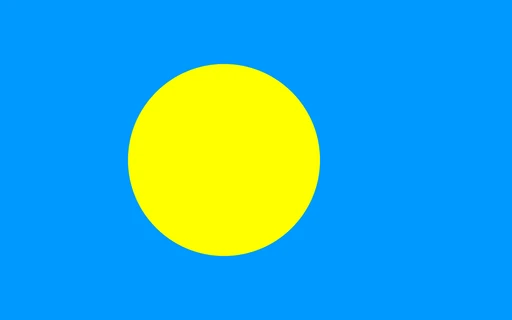
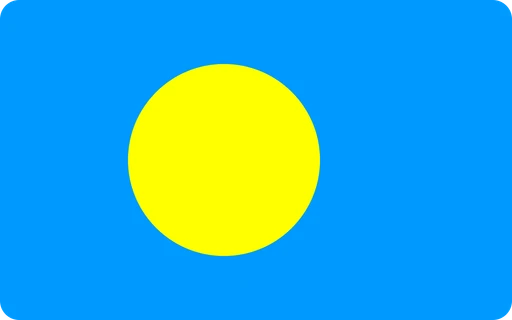
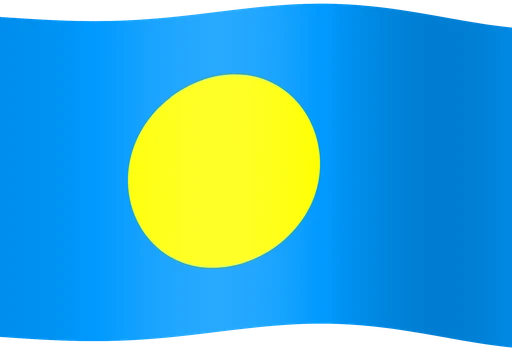
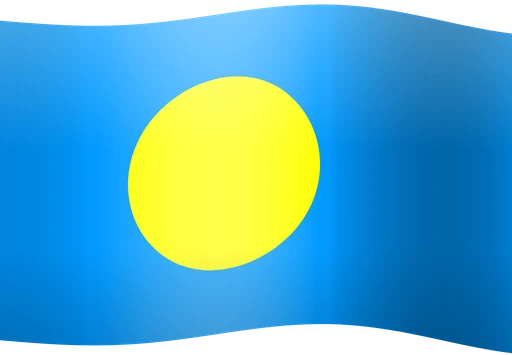
The flag of Palau is a light blue field with a large yellow disk set slightly toward the hoist rather than dead center. The blue is the ocean and Palau's place in it. The yellow disk is the full moon, which in Palauan culture is associated with peace and tranquility.
The flag of Palau is a light blue field with a golden-yellow disk on it, set a little toward the hoist rather than in the middle. It was adopted on January 1, 1981.
A flag for a new republic
The date marked Palau's move to self-government, out of the Trust Territory of the Pacific Islands that the United States had administered. Decolonization was working its way across the Pacific at the time; Palau's own arrangement was settled later, with the Compact of Free Association signed with the United States in 1994.
The design came from a public competition, which is worth noting: the flag Palauans ended up with was one they chose rather than one handed down by an administering power. It arrived at a point when Palauans were asserting cultural and political autonomy in a number of ways at once.
The moon on a blue field
Light blue is the ocean and the sky, the two things that define daily life on a small island nation, and the color is also read as peace and tranquility.
The yellow disk is the moon. Its cycles have long governed when Palauans plant, harvest, and fish, and Palauan folklore ties the moon to fertility and the harvest. The off-center placement is one of the things that separates Palau's flag from the other circle-on-a-field designs it gets compared with: Japan's, and among its neighbors the Federated States of Micronesia. Blue and yellow show up across Pacific flags generally.
Where it flies
The flag is used at government buildings and on national holidays, most visibly on Independence Day and Constitution Day. Protocol covers position and handling. There are no separate variants for different branches of government; every arm of the state uses the same flag.
References
[1] Palauan Government Official Website: palaugov.pw
[2] North American Vexillological Association: nava.org
Common questions
- What does the yellow circle on Palau's flag mean?
- It is the moon, which matters a great deal in Palauan culture. It stands for brightness and hope, and its cycles have long set the timing for farming and fishing.
- Why is the Palau flag's background blue?
- The blue is the ocean and the sky, both central to life on the islands. It also reads as peace and tranquility.
Featured in these articles
- The Circle That Carries a Nation: How Japan, Bangladesh, and Laos Each Loaded a Simple Disc With Completely Different Meaning
- Green Flags and the Prophet's Color: How Islam Shaped the Palettes of Saudi Arabia, Mauritania, and Beyond
- The Crescent Faces Left, the Crescent Faces Right: Why Orientation Matters More Than You Think
- Four Crescents, Four Stories: How Azerbaijan, Comoros, Palau, and Turkey Use the Moon to Mean Completely Different Things
Download this flag
Free in 12 styles, from 32px icons up to 2000px, as SVG, PNG, WebP and JPG.