The Flag of Mayotte
Department of Mayotte
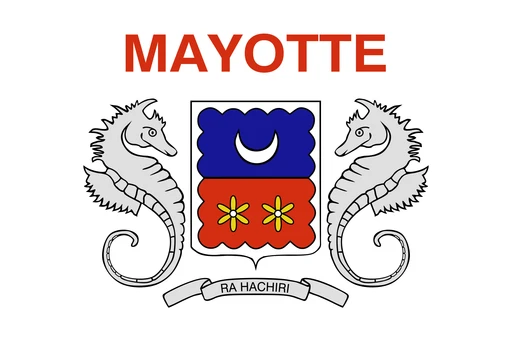
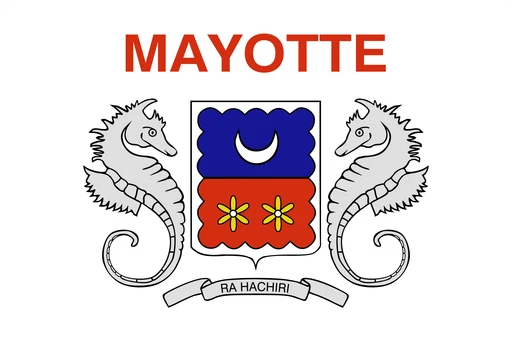
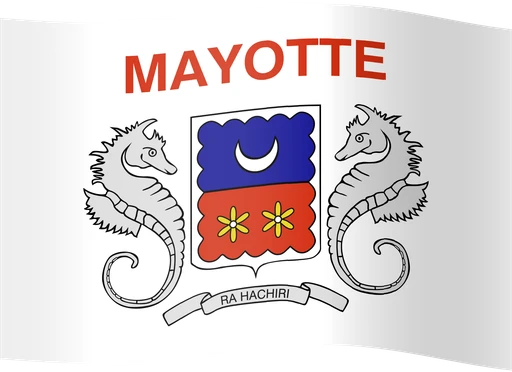
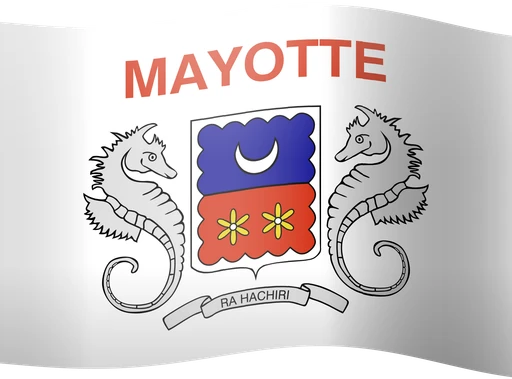
Mayotte is a French overseas department in the Indian Ocean, and its official flag is the French Tricolore: three vertical bands of blue, white, and red, identical to the national flag of France. Alongside it, a local banner is widely used: a white field carrying the departmental coat of arms, two silver seahorses flanking a shield with a silver crescent above and two gold ylang-ylang flowers below, with the motto Ra Hachiri. That banner has no official standing as a territorial flag.
Mayotte occupies a peculiar position in the world of flags. It is a French overseas department and region in the Indian Ocean, between Madagascar and the coast of Mozambique, and it officially flies the French Tricolore. Yet a tradition of local emblems, departmental arms, and informal symbols tells a more layered story about sovereignty and belonging, one that follows from the island's unusual path out of the Comoros archipelago and into full French département status in 2011.
The island that chose France
In 1974, France held a referendum across the four islands of the Comoros archipelago. Three islands voted overwhelmingly for independence. Mayotte didn't. By a margin of 63.8%, Mahorais voters chose to stay French, a decision they confirmed in a 1976 referendum with an even more emphatic 99.4% majority. That double refusal shaped everything that followed, including the island's relationship with flags.
Because Mayotte never broke from France, it never went through the nation-building exercise of designing a new national flag. There was no independence ceremony, no flag-raising moment, no committee of revolutionaries sketching symbols of liberation on the back of a napkin. The Comoros got all of that. Mayotte got the Tricolore, by its own choice.
The consequences rippled forward for decades. When Mayotte was elevated from a "collectivité départementale" to France's 101st département and 26th region on March 31, 2011, whatever ambiguity remained about its semi-autonomous status dissolved. The Tricolore became not just customary but constitutionally mandatory. The African Union and the Union of Comoros have never accepted this arrangement. The UN General Assembly passed multiple resolutions in the 1970s affirming Comorian sovereignty over Mayotte, and the Comoros constitution explicitly names Mayotte as one of its four islands. Flying the French flag in Mamoudzou is a geopolitical statement, contested by a neighboring state and by a continental body.
Blue, white, and red over the Indian Ocean
As an integral part of the French Republic, Mayotte uses the Tricolore with no modification: no local emblem tucked into the corner, no additional stripe. Three equal vertical bands of blue, white, and red in a 2:3 ratio, prescribed by Article 2 of the French Constitution. Mayotte has no legal authority to alter it and no official desire to.
In practice the Tricolore flies over the prefecture in Mamoudzou, at citizenship ceremonies, on school buildings, and at every official function, identical in every respect to flags flown in Paris, Lyon, or Marseille. That sameness is the point.
It puts Mayotte in a different position from most other French overseas territories. French Polynesia has its own widely recognized red-and-white flag with a pirogue emblem. New Caledonia flies the Kanak flag alongside the Tricolore following the 2010 decision to display both. Martinique went further still and voted itself an official flag in 2023. Mayotte has no distinct flag at all, only a banner made out of its coat of arms, and that restraint is itself a meaningful symbol: a deliberate embrace of full integration rather than autonomy.
The departmental coat of arms
Mayotte lacks a territorial flag, but it is hardly without local visual identity. The departmental coat of arms does the heavy lifting, appearing on official documents, government communications, and the département's institutional branding, and it is the thing people mean when they talk about the Mayotte flag.
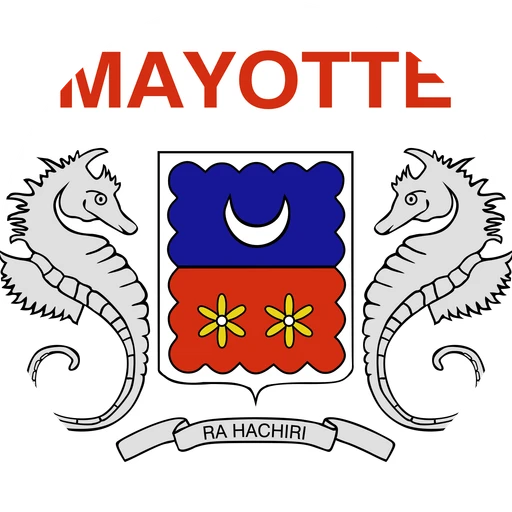
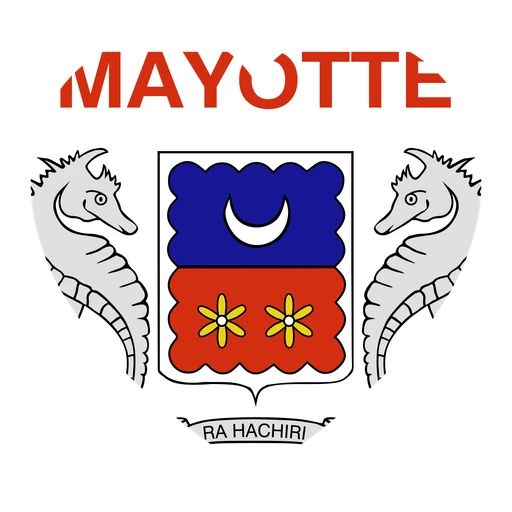
The arms were adopted by the General Council on 23 July 1982, from a design by Michel Chabin illustrated by Pascale Santerre, and the department inherited them in 2011. The shield is divided horizontally: a silver crescent on blue in the upper half, two gold ylang-ylang flowers on red in the lower half, the whole enclosed by a silver border with a scalloped edge. Two silver seahorses stand as supporters on either side, and a scroll below carries the motto.
Every element is doing a job. The blue and red come straight from the French flag. The crescent is for Islam, the religion of almost the entire population. The ylang-ylang flowers are for the island's main agricultural export: Mayotte is one of the world's leading producers of ylang-ylang essential oil, the fragrant extract used in perfumes from Chanel No. 5 to countless others. And the seahorses are a visual pun. Mayotte, seen from above, is roughly the shape of a seahorse, and the arms let the island stand as its own supporters.
The motto is "Ra Hachiri," or "We are vigilant" in Shimaore, the local Bantu language spoken alongside French. It is a small but potent assertion of local voice within French republican identity, and, given how much of Mahorais politics has turned on the question of staying French, not an idle one.
Other local images do plenty of work outside the arms. The coelacanth, a prehistoric deep-sea fish believed extinct for 66 million years until a living specimen turned up in a South African fish market in 1938, swims in the deep waters around the Comoros and Mayotte and shows up constantly in local branding. So does the traditional Mahorais outrigger pirogue. Neither is part of the coat of arms.
In practice the arms get put on a white field, often with the words "Département de Mayotte" alongside them, and flown. The departmental council uses that banner, and so do civic groups. It is a quasi-flag that occupies an ambiguous but very real space in Mahorais public life.
The symbols Mahorais people actually wave
Official flags tell one story and the streets tell another. At local sporting events, cultural festivals, and political demonstrations, Mahorais people regularly display unofficial banners that blend the Tricolore with local symbols. This grassroots vexillology does not appear in government registers, but it is real and visible. Green features prominently in many of these displays, carrying heavy cultural weight on an island where roughly 95 to 97 percent of the population is Muslim. Green banners and accents show up at community gatherings and religious occasions as naturally as blue-white-red does at civic ones.
Several municipalities within Mayotte maintain their own communal arms. Mamoudzou, Dzaoudzi, and Bandraboua all have heraldic emblems used in local governance, occasionally rendered on flag-like formats for town halls and official events. None carries legal standing as a territorial flag, but they fill a visual gap.
The comparison with Réunion is instructive. That other French Indian Ocean département also officially uses only the Tricolore, but its population has spent years debating competing proposals for a regional flag, with designs featuring the volcano Piton de la Fournaise or stylized vanilla flowers generating passionate argument. Mayotte has not seen that level of organized flag debate, though recent tensions, including the controversial "Wuambushu" anti-immigration operations launched in 2023, have pushed questions of Mahorais identity into sharper focus.
Neighbors and rivals
The flag of the Union of Comoros makes the sovereignty dispute visible in fabric and dye. Its four horizontal stripes of yellow, white, red, and blue represent the four islands of the archipelago, and a green triangle at the hoist bears a white crescent and four white stars. Each star corresponds to an island. One of them represents Mayotte, which the Comoros constitutionally claims as "Maore." It is arguably the only national flag in the world that symbolically claims territory administered by another sovereign state right there in its design.
Nearby Madagascar flies vertical white and horizontal red-green bands, a flag rooted in the old Merina kingdom. Réunion mirrors Mayotte's situation with the Tricolore as its sole official flag. The Scattered Islands (Îles Éparses), tiny French possessions across the Mozambique Channel and Indian Ocean, have no distinct flags at all, just the Tricolore over weather stations and military outposts.
Mayotte's situation finds echoes in other territories caught between political identities. Gibraltar flies its own banner but remains British. Western Sahara's Sahrawi flag is recognized by some nations and ignored by Morocco. Kosovo's blue-and-gold flag is accepted by over 100 countries and rejected by Serbia. In each case the flag flown is a claim about reality that not everyone agrees on.
Proposals that never went anywhere
Unlike Gibraltar or Kosovo, Mayotte has no widely circulated formal proposal for a distinct territorial flag. The absence is not accidental. It reflects a population that voted, twice, for French integration and broadly sees the Tricolore as its own flag rather than an imposed one.
Online vexillology communities like Flags of the World (FOTW) document the absence dutifully, noting the lack of an official distinct flag while cataloging the occasional fan-designed proposal that surfaces on forums. These typically combine the Tricolore's colors with ylang-ylang motifs or crescent symbols, and none has gained political traction.
The debate, such as it is, runs along predictable lines. Some voices argue that a distinct flag would strengthen local cultural identity without threatening French belonging, the way Brittany's Gwenn-ha-du or Corsica's Moor's Head flag coexist comfortably with the Tricolore. Others counter that any deviation invites the very separatism Mayotte explicitly rejected, and that the Comoros would seize on a distinct Mahorais flag as evidence of incomplete integration.
There is a broader French context too. The republican tradition has long been skeptical of subnational flags. Unlike the UK, Spain, or Germany, where regional flags are celebrated and constitutionally embedded, France institutionally discourages them for its départements. Mayotte is not unusual in lacking one. It is the norm.
References
[1] French Constitution, Article 2. Official definition of the French national flag. Available at Légifrance
[2] Conseil Départemental de Mayotte. Official departmental website with coat of arms and visual identity documentation. cg976.fr
[3] Flags of the World (FOTW). "Mayotte" entry, primary vexillological reference database. fotw.info
[4] Institut National de la Statistique et des Études Économiques (INSEE). Mayotte department profile, code 976. insee.fr
[5] Smith, Whitney. Flags Through the Ages and Across the World. McGraw-Hill, 1975. Foundational vexillology reference.
[6] Union of Comoros Constitution (2001, amended 2009). Constitutional claim to Mayotte and the symbolism of the four stars in the Comorian flag.
[7] Gevrey, Alfred. Essai sur les Comores. Pondicherry, 1870. Historical source on the pre-colonial and early colonial period of the Comoros archipelago.
[8] Blanchy, Sophie. "Mahorais et Comoriens face à la migration." Revue européenne des migrations internationales. Cultural and political identity context for Mayotte.
[9] Direction des Affaires Culturelles de Mayotte (DAC). Documentation of local cultural symbols including ylang-ylang and coelacanth in official imagery.
Common questions
- What do the seahorses on Mayotte's local flag mean?
- They are a pun on the island's shape. Seen on a map, Mayotte looks like a seahorse, so the two silver seahorses holding up the shield are the island describing itself. They come from the departmental coat of arms, which is what the widely used local banner carries. That banner is not an official flag: Mayotte's official flag is the French Tricolore.
- Does Mayotte have its own flag?
- Not officially. Since becoming a French département in 2011 its only official flag is the French one, which is what Mayotte wanted: it voted twice to stay part of France instead of joining the independent Comoros. What you will actually see locally is a white banner bearing the departmental arms, often with the words Département de Mayotte on it, used by the departmental council and at local events without any legal standing.
- Why does the Comoros flag include a star for Mayotte?
- The Comorian flag has four stars, one for each island in the archipelago, including Mayotte. The Comoros constitution still claims Mayotte as its territory and calls it 'Maore', so that flag is claiming land France actually governs. It's a territorial dispute you can read right off the cloth.
Featured in these articles
Download this flag
Free in 12 styles, from 32px icons up to 2000px, as SVG, PNG, WebP and JPG.