The Flag of Kuwait
State of Kuwait
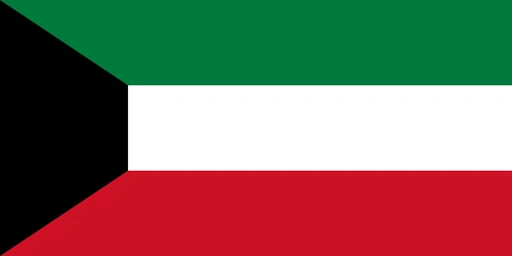
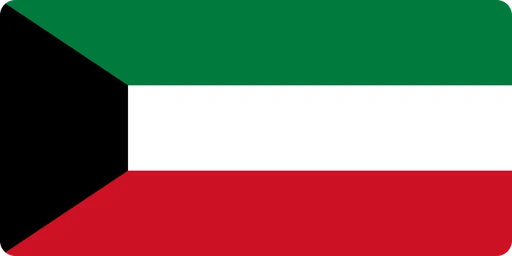
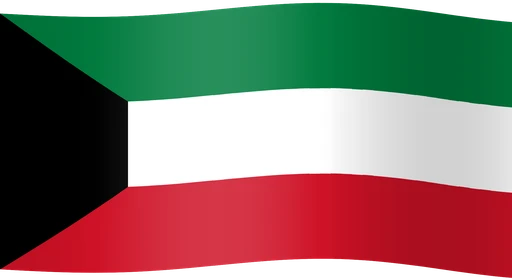
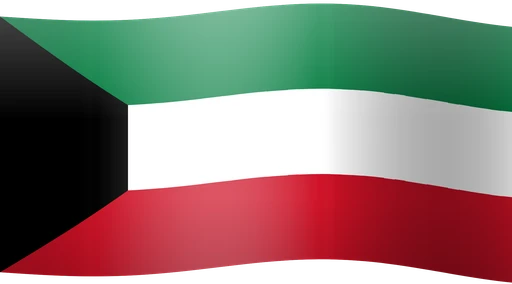
The flag of Kuwait is a horizontal triband of green, white, and red with a black trapezoid extending from the hoist. Green is for the fertile lands, white for the deeds of the country, red for the enemies' blood, and black for the battles Kuwait has faced. The layout follows the Arab Revolt flag patterns.
Kuwait's flag is one of very few national flags built around a trapezoid, a black shape at the hoist that sets it apart from the rectangles and triangles most flags use. It was adopted on September 7, 1961, months after Kuwait gained full independence from Britain. Its four colors, green, white, red, and black, come from a 13th-century poem by Safi al-Din al-Hilli.
A 13th-century poem behind the colors
Most countries pick flag colors from a menu of political ideals or geographic features. Kuwait went to the poetry shelf. The four colors trace to a celebrated verse by the 13th-century Arab poet Safi al-Din al-Hilli: "White are our deeds, black are our battles, green are our fields, red are our swords." That compact piece of writing gave an entire political movement its visual vocabulary.
Those four colors form the backbone of the Pan-Arab color tradition, shared by nations from Jordan to the UAE to Sudan. Kuwait's adoption isn't borrowed shorthand, though. It is tied to the specific literary source, chosen to anchor a brand-new state in Arabic civilization. When Kuwait's leaders selected the colors in 1961, they weren't just joining a club, they were making a claim about cultural continuity.
In the Kuwaiti reading, each color has a tuned meaning. Green is the fertile land and the nation's prosperity. White is purity and the peace embodied in the country's actions. Red recalls the blood shed in defense of honor and sovereignty. Black marks the defeat of enemies on the battlefield.
The broader Pan-Arab color movement traces to the flag of the Arab Revolt in 1916, when Sharif Hussein of Mecca raised a banner against Ottoman rule. That flag's influence spread through the Hashemite kingdoms and into the postcolonial era. Kuwait sits squarely in the tradition, but it distinguishes itself by keeping the literary thread visible, tying the flag back to al-Hilli's verse in official publications and educational materials.
The trapezoid
At the hoist, where most flags place a vertical stripe or a canton, Kuwait has a black trapezoid that juts into the horizontal bands of green, white, and red. It's not a rectangle and it's not a triangle. It is wider at the top and bottom edges of the flag and narrows as it reaches into the field. You don't see this anywhere else.
The three horizontal bands run the full length of the fly in equal proportions: green on top, white in the middle, red on the bottom. The black trapezoid overlaps all three, which makes the composition read as unified rather than segmented. The official proportions are 1:2, and the geometry of the trapezoid is codified in Kuwaiti law, down to the angle of its sloping edge.
Why a trapezoid? Practicality played a role alongside aesthetics. When Kuwait's designers sat down to create a flag for independence, they faced a real problem: Jordan, Palestine, and several other Arab states already used the same four colors in similar arrangements. A standard tricolor with a vertical or triangular hoist element would have been easily confused at a distance, especially at sea or at international gatherings. The trapezoid solved that instantly, and no other sovereign nation uses one.
Unconventional hoist shapes are rare worldwide. Nepal's double pennant is the most famous example of a non-rectangular national flag. Kuwait's approach is less radical but arguably more clever: it keeps the familiar rectangular format and introduces a geometric element that breaks the visual monotony. The design was commissioned as Kuwait prepared to enter the world stage, and its creators intended it to be unmistakably Arab in spirit and uniquely Kuwaiti in form.
1961, and the flag's first tests
For over sixty years Kuwait flew a red flag. Under the British protectorate arrangement that began in 1899, the sheikhdom used variations of a red banner, sometimes with a white vertical stripe or the word "Kuwait" inscribed in Arabic script.
That changed on June 19, 1961, when Kuwait declared independence from Britain. A sovereign nation couldn't fly a colonial-era banner, and the design process moved quickly. On September 7, 1961, Amiri Decree No. 8 established the new national flag, less than three months after independence. Sheikh Abdullah Al-Salem Al-Sabah, Kuwait's ruler at the time, oversaw the process, and the design drew on input from cultural advisors who insisted on the al-Hilli connection.
The flag faced its first serious test almost immediately. Days after Kuwait declared independence, Iraqi leader Abd al-Karim Qasim claimed Kuwait as Iraqi territory, nearly triggering a military confrontation. British troops deployed to deter an invasion, and the new flag became an overnight symbol of sovereignty under threat.
The pattern repeated far more violently three decades later. On August 2, 1990, Iraqi forces invaded and occupied Kuwait. For seven months the Kuwaiti flag disappeared from its own territory, but not from the world. Kuwaiti exiles and the government-in-exile flew it constantly, at the United Nations, at diplomatic meetings, and at rallies across Europe and the Americas, where it became the most recognizable symbol of Kuwaiti resistance and legitimacy during the occupation.
When coalition forces liberated Kuwait in February 1991, the raising of the flag over Kuwait City was one of the most emotionally charged moments in the country's history.
Protocol and variants
Amiri Decree No. 8 of 1961 doesn't just establish the design, it governs how the flag may be used, displayed, and protected. Desecration carries legal penalties, and regulations cover everything from the size of flags on government buildings to the protocol for half-masting during periods of national mourning.
At the Amiri Diwan, the Emir's court, the national flag flies alongside the ruler's personal standard, which carries distinct markings that differentiate it from the civil flag. Kuwait's naval ensign and Coast Guard variant use the national colors but adapt the layout for maritime identification, following international conventions for visibility at sea.
Two dates dominate the Kuwaiti flag calendar: National Day on February 25 and Liberation Day on February 26. During these celebrations the flag is everywhere, on cars, buildings, clothing, and public installations. Flag etiquette is observed carefully at international organizations where Kuwait holds membership, including the United Nations, the Arab League, and the Gulf Cooperation Council, where Kuwait is a founding member.
One unusual episode came in 2015 and 2016, when the International Olympic Committee suspended Kuwait's Olympic committee over government interference in sports. Kuwaiti athletes competed at the 2016 Rio Olympics under the neutral Olympic flag, which caused significant domestic frustration.
Kuwait among the Pan-Arab flags
Line up the flags of the Arab world and the problem becomes obvious. Jordan, Palestine, Sudan, the UAE, Yemen: green, white, red, black, in various configurations. From a distance, or in a thumbnail image, several of them blur together. It's a genuine identification challenge, and vexillologists have written about it extensively.
Kuwait's trapezoid solves the problem. No other Pan-Arab flag uses the shape, and it gives Kuwait instant recognizability even at small sizes. Where Jordan uses a triangle and Palestine uses the same triangle without the star, Kuwait's sloping black form is unmistakable.
Among the six GCC states the flags form something like a family portrait: all clearly Arab, all clearly distinct. Bahrain and Qatar use serrated edges. Saudi Arabia places a sword and the shahada on green. The UAE stacks the four Pan-Arab colors. Oman uses a national emblem. Kuwait alone uses geometry.
Vexillological organizations have generally praised the design for that reason. Assessments from groups like the North American Vexillological Association and the Flag Institute note that the trapezoid gives the flag strong identifiability, one of the key criteria for effective flag design. Whether it directly influenced any other nation's design thinking is debatable, but its success in solving the similarity problem is widely acknowledged.
References
[1] Kuwait Ministry of Information, official government publications on national symbols and the flag decree.
[2] Amiri Decree No. 8 of 1961 (September 7, 1961), the founding legal instrument establishing the national flag of Kuwait.
[3] Flag Institute, entry on the Flag of Kuwait, including historical flag variants. https://www.flaginstitute.org
[4] Flags of the World (FOTW), detailed vexillological analysis of Kuwait's flag, proportions, and variants. https://www.fotw.info
[5] Al-Hilli, Safi al-Din, original Arabic verse and modern scholarly translations documenting the poetic source of Pan-Arab colors.
[6] Finnie, David H., Shifting Lines in the Sand: Kuwait's Elusive Frontier with Iraq (1992, Harvard University Press).
[7] Smith, Whitney, Flags Through the Ages and Across the World (1975, McGraw-Hill).
[8] North American Vexillological Association (NAVA), peer-reviewed papers on Pan-Arab flag design and differentiation.
[9] International Olympic Committee Archives, records of Kuwait's 2015-2016 suspension and athletes competing under neutral flag.
Common questions
- What do the colors on Kuwait's flag stand for?
- Green stands for fertility and hope, white for peace, red for courage and valor, and black for the defeat of enemies.
- What's the meaning behind the black trapezoid on Kuwait's flag?
- The black trapezoid stands for the defeat of enemies. It is also the feature that makes Kuwait's flag impossible to confuse with the other Pan-Arab flags.
Featured in these articles
- One Poem, Two Flags: How the Arab World's Colors Split Into Rival Family Trees
- The Serrated Secret: Why Bahrain and Qatar Share the Same Zigzag, and What Britain Had to Do With It
- Guilty by Association: How Libya, Saudi Arabia, and Algeria Put Sacred Text on Their Flags, and Why Almost No One Else Dared
- The Sahrawi Riddle: How Western Sahara Flies a Flag for a Country That Doesn't Fully Exist
Download this flag
Free in 12 styles, from 32px icons up to 2000px, as SVG, PNG, WebP and JPG.