The Flag of the Central African Republic
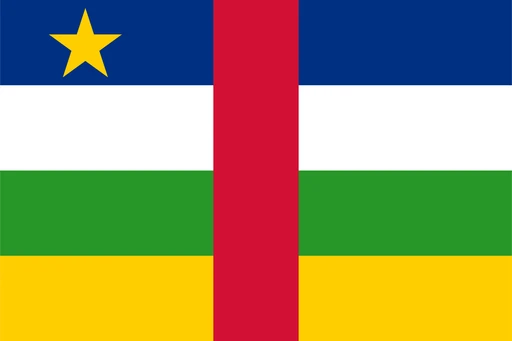
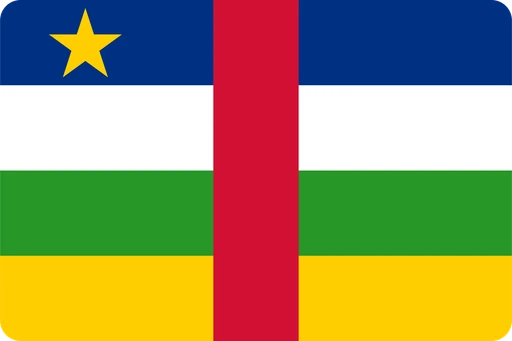
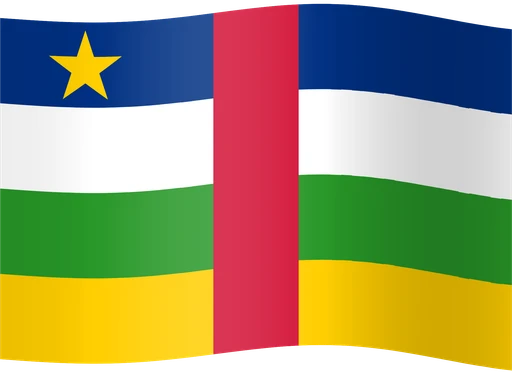
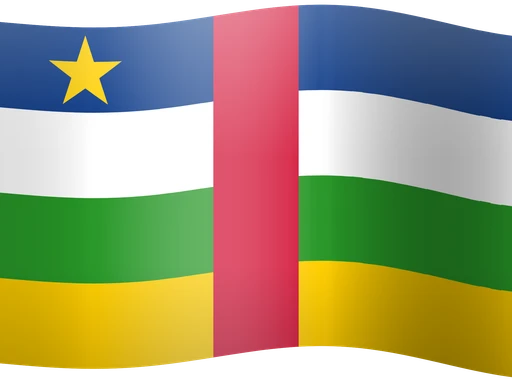
The flag of the Central African Republic features four horizontal stripes of blue, white, green, and yellow, with a vertical red stripe in the center, intersecting them all. In the upper left corner, on the blue stripe, there is a single yellow five-pointed star. This flag design symbolizes the country's location in Africa, its peace and dignity (white), natural resources and vegetation (green), and the unity of its people (red). The yellow star represents independence.
The Central African Republic's flag was designed to hold two political traditions in one composition. Adopted on December 1, 1958, two years before full independence from France, it came from Barthélemy Boganda, the country's founding father, who wanted a design that joined Africa to Europe and the colonial past to a sovereign future. A single red vertical stripe cuts across four horizontal bands, with a yellow five-pointed star in the upper left corner. It is a flag of reconciliation rather than revolution, which reads strangely against everything that happened to the country afterward.
Boganda's design
Barthélemy Boganda was a Catholic priest, an anti-colonial politician, and the first prime minister of the autonomous Central African territory. He was also, in 1958, a flag designer. During the transition to self-governance under the French Community, Boganda personally created the banner that would represent his new nation. His intention was explicit and unusual: marry the pan-African tricolor (green, yellow, red, symbolizing African unity and the continent's liberation movements) with the French Tricolore (blue, white, red, representing the colonial relationship and continued Franco-African ties).
The red vertical stripe was the key. Boganda described it as "the blood of humanity," the element that unified both color schemes. It was a metaphor for shared sacrifice transcending racial and political division. Not a line dividing two halves, but a thread binding them together.
He didn't live to see his country become fully independent. On March 29, 1959, just months after the flag's adoption, Boganda died in a mysterious plane crash. The circumstances have never been satisfactorily explained. He was 48. Independence came on August 13, 1960, without him, but his flag endured as one of his most tangible legacies.
Many post-colonial African flags were changed after coups or regime changes. This one has not been altered since 1958. It survived even Emperor Bokassa I, who seized power in 1965, crowned himself emperor in a lavish ceremony in 1977, and rebranded the country as the Central African Empire. Bokassa changed a great deal. He did not change the flag.
Six panels and a star
Four horizontal stripes, blue, white, green, and yellow from top to bottom, are cut by a single vertical red stripe through the center. The result is a six-panel grid, a cruciform layout that is genuinely rare among national flags. Very few countries intersect horizontal and vertical stripes this way, which makes the CAR flag easy to pick out in a lineup.
In the upper-left corner, against the blue, sits a yellow five-pointed star. Boganda called it the guiding star of the people.
The colors work better read together than one at a time. Blue is the sky and freedom, and also France. White is peace and dignity. Green is the dense equatorial forest across the south of the country. Yellow is the savanna of the north and, more abstractly, the tolerance needed to hold a diverse nation together. Red, the central stripe, is the blood shed by the country's people and the shared blood of all humanity. It is the only color in both the pan-African and French palettes, which is why Boganda put it at the center.
The proportions are 3:5, height to width, and the five stripes are all of equal width.
The flag through coups and an empire
The Central African Republic has had more than its share of political chaos: coups in 1965, 1979, 1981, 2003, and 2013, along with civil wars and foreign military interventions. No government has altered the flag through any of it.
When Bokassa declared himself Emperor in 1976 he adopted elaborate imperial standards and personal heraldry but left the national flag alone. Perhaps he understood that some symbols are dangerous to touch. Or perhaps he had other priorities, like ordering a jewel-encrusted imperial crown from Paris.
Boganda's message has held some authority beyond any single regime. During the 2013-2014 sectarian crisis, when Séléka rebels and anti-balaka militias tore the country apart along religious lines, both sides and the peacekeeping advocates invoked the flag as a symbol of national unity. It belonged to everyone, which meant nobody could claim it exclusively.
Pan-African colors, French echoes
Across West and Central Africa, the pan-African palette is everywhere. Chad's flag uses blue, yellow, and red. Mali's uses green, gold, and red. Guinea's uses red, yellow, and green. Cameroon layers pan-African stripes with a central star. But none of these flags deliberately incorporates the French blue in the way the CAR flag does. Boganda's design stands alone in its explicit fusion of African and European traditions.
The design followed his politics, summarized in the Sango phrase "Zô kwé zô," meaning "Every person is a person." That creed ran through his constitutional ideas as well as his color scheme. South Africa's 1994 flag draws occasional comparisons for a similar attempt to merge heritages into one composition, though the two flags look nothing alike and came from different centuries. What they share is the assumption that a flag can model a unity the country has not reached yet.
Protocol and usage
The flag flies at all government buildings, military installations, and embassies. Its use is governed by provisions in the national constitution; Title I, Article 17 of the 2016 constitution formally defines the national flag. There's no separate Flag Day, but the flag features prominently in Independence Day celebrations on August 13 and Republic Day on December 1, the anniversary of the flag's own adoption.
You'll find it on military insignia, on the kits of the national football team (Les Fauves, "The Wild Beasts"), and as a common motif among Central African diaspora communities in France, Cameroon, and beyond. The presidential standard incorporates the national flag design with additional insignia, but no widespread commercial or variant versions exist.
In a country where state institutions remain fragile and conflict continues in many regions, the flag is among the most widely recognized symbols of national identity. It outlasted Boganda, who died months after it was adopted, and every regime since.
References
[1] Constitution of the Central African Republic (2016), Title I, Article 17. Official definition of the national flag and its legal status.
[2] Smith, Whitney. Flags Through the Ages and Across the World. McGraw-Hill, 1975. Comprehensive vexillological reference with entries on Central African flags.
[3] Kalck, Pierre. Historical Dictionary of the Central African Republic. 3rd ed., Scarecrow Press, 2005. Detailed historical context on Boganda and the founding of the republic.
[4] Titley, Brian. Dark Age: The Political Odyssey of Emperor Bokassa. McGill-Queen's University Press, 1997. Context on the imperial period and retention of the national flag.
[5] Flags of the World (FOTW), crwflags.com/fotw/flags/cf.html. Peer-reviewed vexillological database entry on the Central African Republic.
[6] International Crisis Group. Reports on the Central African Republic, 2013-2024. Context for the flag's role during recent sectarian conflicts and peacekeeping efforts.
Common questions
- What does the yellow star symbolize on the Central African Republic flag?
- The yellow star in the top corner stands for independence. Boganda, who designed the flag, called it the guiding star of the people.
- Who designed the flag of the Central African Republic?
- Barthélemy Boganda designed it in 1958. He was a Catholic priest who became an anti-colonial politician and the country's founding father. He wanted the flag to bridge African and European traditions. Sadly, he didn't live to see full independence in 1960. He died in a mysterious plane crash in March 1959.
Featured in these articles
Download this flag
Free in 12 styles, from 32px icons up to 2000px, as SVG, PNG, WebP and JPG.