The Flag of Bolivia
Plurinational State of Bolivia
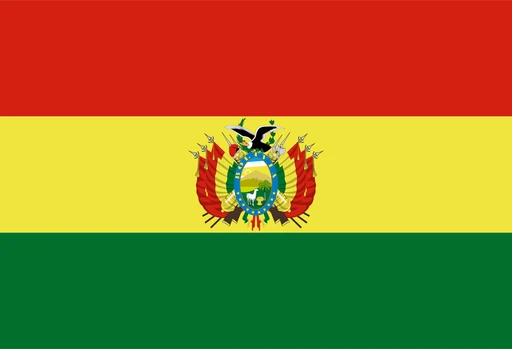
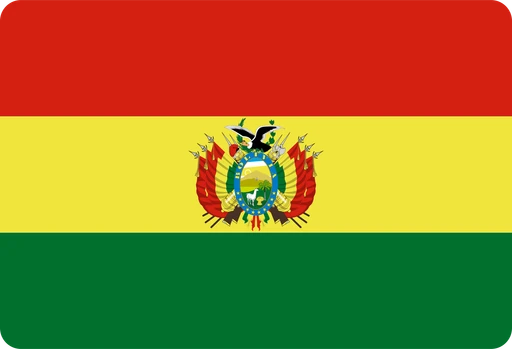
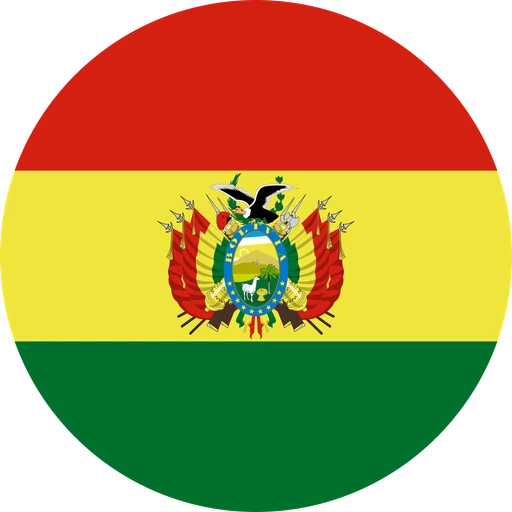
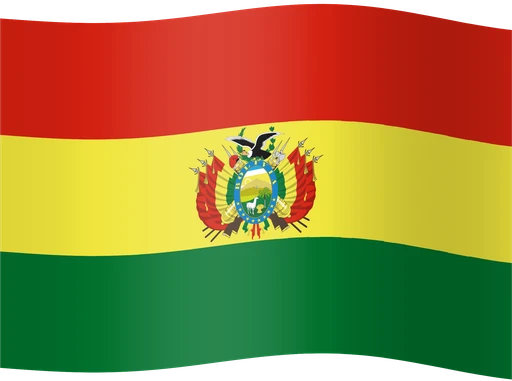
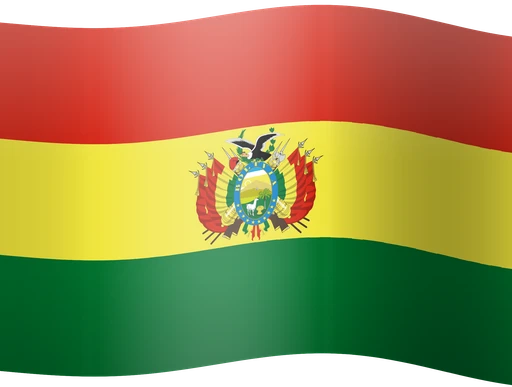
The flag of Bolivia has three horizontal stripes of equal width: red, yellow, and green from top to bottom. The state version carries the Bolivian coat of arms at the center of the yellow stripe. Bolivians call it the tricolor.
Bolivia has two official flags. The familiar tricolor of red, yellow, and green, the bandera nacional, flies as the civil flag. The wiphala, a square patchwork of rainbow-colored diagonal stripes rooted in Andean indigenous tradition, was raised to co-equal status in the 2009 constitution. The pairing reflects a country still negotiating its identity between a Spanish colonial past and an indigenous majority.
The wiphala and the tricolor
Bolivia is one of very few countries with two co-official national flags. The 2009 Constitution, drafted under President Evo Morales, recognized the wiphala alongside the tricolor in Articles 6 and 7, putting indigenous identity into the constitutional text of the state.
The wiphala is a 7x7 square grid of small colored squares arranged in diagonal rainbow stripes. Its origins are debated. Some scholars trace it back centuries to pre-Columbian Andean civilizations; others argue its use as a political emblem is more recent, emerging from indigenous rights movements in the 20th century. Either way, it is now inseparable from Aymara and Quechua identity across the highlands. Different color arrangements correspond to different Andean regions, with the Qullasuyu variant (white diagonal center stripe) covering the area roughly corresponding to modern Bolivia.
The flag became a flashpoint during the 2019 political crisis. When Morales resigned and left the country amid disputed elections, opponents tore wiphalas from government buildings. Images of the flag being ripped apart and burned spread across social media and galvanized indigenous communities well beyond the immediate political dispute. For many, the attack on the wiphala felt like an attack on their existence.
The dual-flag system remains contentious. Supporters see it as overdue recognition of Bolivia's majority-indigenous population. Critics call it partisan, tied too closely to Morales and his Movement for Socialism (MAS) party. The argument has not gone anywhere.
How the tricolor took its final form
Bolivia declared independence from Spain on August 6, 1825, and took its name from Simón Bolívar, the Venezuelan-born liberator whose campaigns swept across South America. The country's first flags borrowed heavily from the revolutionary iconography of the era: bold colors, stars, laurel wreaths.
The earliest flag, adopted in 1825, had green and red horizontal stripes with a gold star surrounded by laurel branches. It did not last long. Within months a second design appeared in 1826, introducing yellow, red, and green horizontal stripes. This was the ancestor of the modern tricolor, though the order of the bands would shift before settling.
The final arrangement, red on top, yellow in the middle, green on the bottom, was formally adopted on October 31, 1851, under President Manuel Isidoro Belzu. Belzu was a populist who drew support from Bolivia's working classes and indigenous communities, so the flag was fixed in a moment of national identity being asserted from below rather than by the creole elite alone.
The flag's emotional weight grew heavier after the War of the Pacific (1879-1884), when Bolivia lost its entire coastline to Chile. That loss turned the tricolor into a marker of what had been taken. Every Bolivian schoolchild learns about the Litoral, the lost coastal department, and the flag carries that grief. Bolivia still marks Día del Mar (Day of the Sea) every March 23, and the flag flies prominently at those commemorations.
What red, yellow, and green stand for
The red stripe at the top is blood, specifically the blood of those who fought and died for Bolivian independence and sovereignty. It is a common enough symbol on Latin American flags, but in Bolivia, where political violence has punctuated nearly every generation, it feels less abstract than it might elsewhere.
Yellow, the center band, represents mineral wealth, and the symbolism carries real history. Bolivia's silver deposits, concentrated in the Cerro Rico mountain at Potosí, financed the Spanish Empire for two centuries. Potosí was one of the largest and wealthiest cities in the world by the early 1600s, rivaling London and Paris in population. Millions of indigenous and African enslaved laborers died extracting that silver. The yellow stripe also covers gold and tin, the latter of which dominated Bolivia's economy through much of the 20th century.
Green, at the bottom, stands for the fertility of Bolivia's land, its agricultural abundance, and hope for the future. From the high altiplano to the tropical lowlands of the Amazon basin, Bolivia's ecological diversity is considerable, and the green stripe acknowledges it.
The state flag variant, the bandera del estado, places the national coat of arms at the center of the yellow stripe. The arms show Mount Potosí, an alpaca, a breadfruit tree, and an Andean condor. Ten stars ring the lower portion: nine for Bolivia's current departments, and one for the lost Litoral.
Variants and protocol
Bolivia distinguishes between the plain tricolor, the civil flag used by citizens and private institutions, and the state flag, which carries the coat of arms on the yellow band. Government buildings, embassies, and official ceremonies use the state flag.
Bolivia also has a navy. The country has been landlocked since 1884, but the Armada Boliviana patrols Lake Titicaca, the Amazon river basin, and other internal waterways. The naval ensign flies on Bolivian vessels, a pointed reminder that Bolivia has never accepted the loss of its coast as permanent.
Flag Day falls on August 17, marking the date the tricolor was first officially raised. On that day and during other national observances, the wiphala is displayed alongside the tricolor at government buildings, as the 2009 constitution requires. During periods of national mourning the flag flies at half-staff. Military and presidential standards also exist, though these are rarely seen outside formal state and military functions.
Bolivia's flag in a continental context
Bolivia's red-yellow-green tricolor sometimes gets confused with the flags of Ghana, Lithuania, or Ethiopia. The resemblance is coincidental. Ghana's colors derive from Pan-African symbolism, Lithuania's from its own medieval and national traditions, and Ethiopia's from a separate set of meanings tied to African unity. Bolivia's palette comes entirely from South American liberation-era design.
Across the Andes, the flags of Venezuela, Colombia, and Ecuador share a tricolor tradition descended from Francisco de Miranda's original banner, which Bolívar carried into battle. Bolivia's flag is a cousin of sorts, born from the same revolutionary moment even if the design diverged.
The wiphala's influence has spread well beyond Bolivia's borders. It now appears at indigenous rights demonstrations in Peru, Ecuador, and Argentina as a Pan-Andean emblem. One common point of confusion: the wiphala is not the rainbow flag of Cusco, Peru. That flag, adopted by the city in 1978, has horizontal stripes and a separate origin, though the two are frequently mixed up.
A flag still being fought over
Bolivia's flags remain among the most politically charged in the Americas. In 2019, people were beaten in the streets for carrying, or not carrying, one flag or the other. The wiphala's desecration during that crisis drew a line between communities that has not healed.
Bolivia's maritime claim against Chile, taken to the International Court of Justice, ended in a 2018 ruling against Bolivia. The court found that Chile had no obligation to negotiate sovereign access to the sea. The decision stung without ending the aspiration, and the tenth star on the coat of arms still stands for the lost coastline.
For many indigenous Bolivians the wiphala carries a weight the tricolor does not. The tricolor was designed by creole elites in the 19th century; the wiphala speaks to something older and, for highland communities, more authentic. Others see the tricolor as the flag of all Bolivians regardless of ethnicity, and resent the wiphala's elevation as a political project. Both views are sincerely held, and neither side looks likely to give ground.
References
[1] Constitución Política del Estado Plurinacional de Bolivia (2009), Articles 6 and 7. Official legal basis for the dual-flag system. Available via the Gaceta Oficial de Bolivia.
[2] Smith, Whitney. Flags Through the Ages and Across the World. McGraw-Hill, 1975. Comprehensive vexillological reference with detailed entries on Bolivian flag history.
[3] Albó, Xavier. Movimientos y poder indígena en Bolivia, Ecuador y Perú. CIPCA, 2008. Essential context on the wiphala's role in indigenous political movements.
[4] International Court of Justice, Obligation to Negotiate Access to the Pacific Ocean (Bolivia v. Chile), Judgment of 1 October 2018. https://www.icj-cij.org/case/153
[5] Mesa Gisbert, Carlos D. Historia de Bolivia. Editorial Gisbert, 2012. Standard Bolivian historical reference covering flag adoption and political context.
[6] Flags of the World (FOTW), Bolivia page. Detailed vexillological descriptions and variant catalog. https://www.crwflags.com/fotw/flags/bo.html
Common questions
- What do the colors of the Bolivian flag mean?
- The red symbolizes the blood of national heroes. Yellow represents Bolivia's mineral wealth. Green stands for the fertility of the land.
- Why does Bolivia have two official flags?
- Bolivia recognizes the national tricolor and the indigenous wiphala as co-equal flags, a way of giving the country's indigenous majority a place in its official symbolism.
- Why does Bolivia have two official flags?
- Back in 2009, President Evo Morales pushed through a new constitution that made the wiphala a co-equal national flag alongside the traditional red-yellow-green tricolor. The wiphala is a square banner with rainbow-colored diagonal stripes, and it's deeply tied to Andean indigenous identity. Bolivia's population is majority-indigenous, so the dual-flag system was a way to honor both that heritage and the country's colonial-era roots.
Featured in these articles
- Bolivia Wrote a Second Flag Into Its Constitution. Then the Fighting Started.
- The Only Flag in the World That Lies to You Depending on Which Side You're Standing On
- Borrowed Glory: How Ethiopia's Colors Became the Grammar of Black Liberation
- The Cedar, the Clove, and the Wheat: Why Some Flags Chose a Crop Over a Crest
Download this flag
Free in 12 styles, from 32px icons up to 2000px, as SVG, PNG, WebP and JPG.